Chapter 1 - The Man Who Bowed to My Wheelchair
You asked what that night was really like, so I'll tell it the way I remember it, not the way it looks on a phone.
The Winter Rose Gala was my father's idea, the way everything in our family was my father's idea.
He held it every December in the ballroom of the Hayes Hotel on Wacker, and for sixteen months he had pushed me through it like something made of glass.
I was twenty-eight years old, and I had not stood on my own feet since a truck ran a red light on Lake Shore Drive and killed my mother in the seat beside me.
My spine was bruised, not severed — incomplete, the doctors kept saying, as if that word were a gift.
Sixteen months of physical therapy later, it felt more like a joke somebody told behind my back.
So I sat at a table near the orchestra with a plate of food I never touched and let the room fill up with people who knew my father and pretended to know me.
The music was loud enough to lean on.
Then a man came in through the service door beside the kitchen, and I noticed him because he was not looking at the chandeliers.
He wore a coat too thin for December and shoes that had been repaired more than once.
He was somewhere past sixty, gray stubble, and he stood straighter than half the men in that room with better suits.
He looked at the floor, then at the tables, then straight at me.
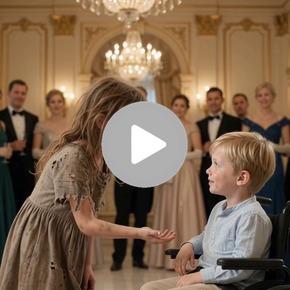
He crossed the room slowly, the way you walk on ice, and stopped in front of my chair.
Then he bowed — a real bow, one hand behind his back — and held out his open palm.
"Shall we dance?"
I remember the room going quiet in my ears, even though the orchestra never stopped.
I remember my father's chair scraping the floor.
He was on his feet and between us before I could blink, one arm out like a gate coming down.
"Don't touch my daughter!"
His face was close to the man's, his jaw locked, and I could see the vein at his temple that I had been watching since I was a child.
My hands clamped down on the armrests of my chair.
My mouth opened and nothing came out.
Then I turned my head toward my father, and something in me that had been asleep for sixteen months sat up.
I lifted my hand, palm out, and heard my own voice crack down the middle of that ballroom.
"Stop!
I want to see what he can do!"
My eyes were burning and my lips were shaking, and I did not care who was watching.
The man did not straighten up.
He lowered himself until his eyes were level with mine, and there was not one drop of pity in them.
"I can make you walk again."
I want to be honest with you about what I thought in that moment, because everybody assumes I believed him.
I didn't.
What I believed was that I was so tired of being handled that I would rather be fooled by a stranger than protected by my own father one more minute.
Then I moved my feet off the footrests.
I don't know how to explain the rest except to say my legs came down and touched the stone floor, and they were cold, and they were mine.
My knees knocked together once, twice, like a chair with a bad leg.
And then they straightened.
I stood up.
I stood up in a room full of people who had spent a year and a half telling me to be careful, and the floor held.
My father took half a step back and raised both hands to his face.
"My God," he said, and his voice came out broken.
"It's a miracle."
Behind him, forks stopped moving.
A woman at the next table put her hand over her mouth.
Then the clapping started, uncertain at first, then everywhere at once.
I was crying and laughing at the same time, and I could not let go of the arm of my chair.
Two of my father's security men had the stranger by the elbow by then, walking him toward the service door so quietly it almost looked polite.
I tried to say wait.
My father's hand closed around my arm, warm and heavy, the way it had closed around everything since the funeral.
He leaned down and spoke into my ear so no one else would hear it.
"That man was never supposed to come near you again."